
Crypto Racing Analysis
UK Horse Racing Crypto Betting: Data-Backed Guide 2026
 Available in US
Table of Contents
- What UK Crypto Horse Racing Bettors Need to Know Right Now
- The State of UK Horse Racing Betting in 2026
- How Crypto Entered Horse Racing Betting
- UK Regulatory Landscape: UKGC, FCA, and the 2026 Crypto Initiative
- The UK Black Market Problem: Why Crypto Matters
- Cryptocurrencies Used in Horse Racing Betting
- Horse Racing Bet Types in Crypto Sportsbooks
- Choosing a Crypto Horse Racing Betting Platform
- What's Next: Blockchain, Smart Contracts, and Tokenised Racing
- Crypto Horse Racing Betting: Questions That Actually Matter
By Crypto Racing Analyst
Updated:

Nine years in this space, and I have never seen two industries collide with this much friction and this much potential. On one side, a UK horse racing betting market worth an estimated 3.7 billion pounds, per IBISWorld’s latest valuation. On the other, a crypto gambling sector that processed at least 81 billion dollars in wagers during 2025 alone, according to data compiled by Surgence Labs and CoinRepublic. The overlap between them is still small, still messy, and still overwhelmingly offshore. But it is growing faster than most people in either industry expected.
I have spent the better part of the last decade tracking cryptocurrency wagering markets, and the past three years specifically watching how blockchain-based betting infrastructure intersects with UK horse racing. What I have found is a niche full of contradictions. The UK Gambling Commission has, for the first time, publicly signalled interest in allowing crypto payments at licensed operators – while simultaneously pouring 26 million pounds into fighting the offshore sites that already accept them. Stablecoins are quietly replacing Bitcoin as the bettor’s coin of choice, yet most guides still talk about crypto betting as if it is 2021. And horse racing, the sport that essentially invented modern bookmaking, is the last major UK betting vertical without a clear crypto pathway.
This guide is built on what the data actually shows. I have pulled numbers from the British Horseracing Authority’s racing reports, the Horserace Betting Levy Board’s annual accounts, the Gambling Commission’s public statements, and the latest crypto gambling research from Surgence Labs and DemandSage. Every claim in here traces back to a source. Where I am offering my own analysis, I will say so. Where the data is incomplete or contested, I will say that too.
Crypto horse racing betting in the UK sits at a crossroads. The regulatory path forward is being drawn right now, the market dynamics are shifting quarter by quarter, and the decisions bettors make today, which coins to use, which platforms to trust, what risks to accept, have real consequences. Here is where things actually stand.
What UK Crypto Horse Racing Bettors Need to Know Right Now
- Every crypto horse racing betting site available to UK punters operates offshore – UKGC-licensed bookmakers cannot accept crypto, though the Commission publicly signalled in February 2026 that it is exploring a pathway to change this.
- The UK’s unlicensed betting market has tripled to 16.6 billion pounds since 2019, and crypto is one of the two main search terms funnelling bettors to offshore operators.
- Stablecoins like USDT are overtaking Bitcoin for betting transactions, projected to handle over 70 percent of crypto wagers in 2026, because they eliminate the volatility risk between deposit and payout.
- The FCA’s cryptoasset regulatory framework launches in October 2027, creating the infrastructure that licensed UK operators would need to accept crypto payments legally.
- UK gambling taxes have risen sharply. Remote Gaming Duty jumped to 40 percent, widening the competitive gap between licensed operators and untaxed offshore crypto sites.
The State of UK Horse Racing Betting in 2026
Last spring, I stood at Cheltenham watching a field of twelve line up for the Gold Cup – the stands packed, the atmosphere electric, the betting ring buzzing. Then I checked the BHA’s quarterly turnover figures a few weeks later and saw a sport that, by the numbers, appears to be shrinking. That disconnect between what you see at the racecourse and what the data says is the most important thing to understand about UK horse racing right now.
The British Horseracing Authority’s 2025 Racing Report confirms it: racecourse attendance hit 5.031 million, the first time it has crossed the five million mark since 2019, representing a 4.8 percent increase on 2024. People want to be at the track. Prize money climbed 3.5 percent to 194.7 million pounds, and the Levy Board set a 2026 prize fund of 77.1 million pounds, up 4.4 million from the previous year. On the surface, British racing looks healthy.
Betting Turnover
Down 4.2% in first nine months of 2025 vs 2024, and 12.8% below 2023 levels, per BHA data
Racecourse Attendance
5.031 million in 2025, first time above 5 million since 2019
Total Prize Money
194.7 million pounds in 2025, up 3.5% year-on-year
Horses in Training
21,728 in 2025, a 2.3% decline from 2024
Levy Board Collection
108.9 million pounds in 2024/25, highest since 2017
Online Share of UK Gambling
56% of all UK gambling revenue now comes from online channels, per DemandSage
But the turnover tells a different story. Overall betting turnover on UK horse racing fell 4.2 percent in the first nine months of 2025 compared with the same period in 2024, and dropped 12.8 percent compared with 2023, according to the BHA. The split is telling: Premier fixture turnover actually rose 2.7 percent, while Core fixture turnover sank 8.6 percent. The big-event wagering holds steady. The everyday bread-and-butter racing is bleeding volume.
Where is that money going? Some of it is simply disappearing from the regulated market. Offcourse operator turnover fell 8 percent year-on-year to 2024/25, 15 percent against 2022/23, and 19 percent compared with 2021/22, all per HBLB Annual Report numbers. With 56 percent of UK gambling revenue now flowing through online channels, the migration to digital is well established. The question is whether that digital migration stays within the licensed system or drifts offshore and increasingly, offshore means crypto.
For anyone betting on horses with cryptocurrency, these numbers are not abstract. The health of the Levy system, which funds British racing through a percentage of licensed bookmaker profits, depends entirely on bets being placed within the regulated perimeter. Every pound wagered at an offshore crypto site is a pound that contributes nothing to the sport itself. I will get into the scale of that black market problem later, but the structural tension is already clear from the market data alone.

The gap between attendance growth and turnover decline raises an obvious question: when and how did crypto enter the horse racing equation?
How Crypto Entered Horse Racing Betting
I remember the exact moment I realised crypto horse racing betting had moved beyond a curiosity. It was late 2021, and Cloudbet became the first major crypto sportsbook to offer dedicated horse racing markets. At the time, most people in the industry shrugged. Crypto betting was a niche within a niche, a handful of Bitcoin casinos processing a few billion dollars a year, mostly on slots and football. Horse racing was not even on the radar.
Cloudbet launched its horse racing vertical in 2021, becoming the first established crypto sportsbook to offer dedicated racing markets. At the time, most crypto platforms considered horse racing too niche to bother with.
Three years later, that dismissiveness looks naive. Crypto casinos and sportsbooks now constitute roughly 17 percent of all iGaming volume globally, according to Surgence Labs’ 2026 Crypto Casino Industry Report. In the first quarter of 2025 alone, crypto platforms processed 26 billion dollars in wagers, nearly double the year-on-year figure, per CasinosBlockchain.io data. The trajectory is not incremental. It is exponential.
Horse racing was slower to attract crypto operators than football or basketball, and the reasons were structural. Racing requires deep market coverage: hundreds of meetings across dozens of tracks, ante-post pricing weeks in advance, each-way terms, exotic bets. Building that out costs money and expertise that most crypto-native platforms did not have. Football is simple by comparison: three outcomes, two teams, global demand. Racing demands granularity.
But the economics eventually forced the issue. As competition among crypto sportsbooks intensified, horse racing became a differentiator. UK racing in particular offered something no other market could: a betting culture so deeply embedded that the sport’s funding model depends on it. For offshore operators looking to attract British punters, adding horse racing was not just a product decision. It was a customer acquisition strategy.
The UK Gambling Commission’s CEO, Andrew Rhodes, captured the shift in a November 2025 briefing when he admitted that what he had considered a problem five years away was now an 18-month to two-year challenge. That kind of language from the head of the regulator tells you everything about how fast the landscape has moved. Crypto horse racing betting is no longer a speculative topic. It is an operational reality that regulators, operators, and bettors are all scrambling to navigate.
UK Regulatory Landscape: UKGC, FCA, and the 2026 Crypto Initiative
February 2026 changed everything. I was following the Betting and Gaming Council’s annual general meeting remotely when Tim Miller, the Gambling Commission’s Executive Director of Research and Policy, said something that made me put my coffee down. He told the room he wanted to start exploring a path forward for crypto assets as a consumer payment option in licensed UK gambling and he said it with the kind of specificity that signalled this was not theoretical. Miller acknowledged the challenges around volatility, anti-money laundering controls, and consumer understanding, but his framing was deliberate: he wanted to approach the question by exploring what was possible rather than finding reasons not to innovate.
Regulatory status as of mid-2026: Cryptocurrency deposits and withdrawals are not permitted at any UKGC-licensed betting operator. All crypto horse racing betting currently available to UK residents takes place on offshore platforms operating under non-UK licences. This may change, but has not changed yet.
What prompted this shift? The Commission’s own illegal market research revealed that crypto is a primary gateway term for British consumers ending up on unlicensed sites. That finding reframed the conversation entirely: crypto was no longer just a payment method to regulate. It was actively pulling bettors out of the licensed system. The pragmatic calculation is straightforward: if licensed operators cannot accept crypto, bettors who want to use it will find operators who do, regardless of licensing status.
The regulatory architecture that currently blocks crypto in UK gambling is not a single rule but a web of interlocking requirements. The Gambling Act 2005 established the UKGC’s licensing framework. Licence conditions require operators to verify customer identity, monitor affordability, and comply with anti-money laundering regulations, all of which assume fiat currency flows that can be traced through the banking system. Crypto does not fit neatly into that model. A Bitcoin deposit does not come with a bank statement. A USDT transfer does not trigger the same AML alerts as a card payment.
FCA Cryptoasset Regime Timeline
The UK government confirmed that the Financial Conduct Authority’s new cryptoasset regulatory framework, established under the Financial Services and Markets Act 2000 via the Cryptoassets Regulations 2025, will launch on 25 October 2027. This regime will cover exchanges, custody providers, and stablecoin issuers, creating the regulatory infrastructure that UKGC-licensed operators would need before accepting crypto payments.
The FCA timeline matters because the Gambling Commission cannot act in isolation.

Layered on top of all this is a tax overhaul that complicates the economics further. Remote Gaming Duty jumped from 21 to 40 percent from April 2026, with Remote Betting Duty set at 25 percent from April 2027, per HMRC’s policy paper. Licensed UK operators are absorbing significantly higher costs, which affects the odds they offer and the margins they operate on. Offshore crypto operators, operating outside the UK tax net, face none of these increases. The competitive gap between licensed and unlicensed is widening at exactly the moment the regulator is trying to bring crypto inside the tent.
For a detailed breakdown of how this UKGC crypto betting policy might unfold and what the specific operational challenges look like, I have written a dedicated analysis. The short version: the direction of travel is clear, the timeline is not.
The UK Black Market Problem: Why Crypto Matters
Here is a number that should alarm anyone who cares about the sustainability of UK horse racing: 16.6 billion pounds. That is the estimated turnover of offshore, unlicensed betting operators serving UK consumers in 2025, according to H2 Gambling Capital data cited by the Betting and Gaming Council. In 2019, that figure was 5 billion. The growth is not gradual – it is a tripling in six years.
The unlicensed offshore betting market in the UK reached an estimated 16.6 billion pounds in turnover by 2025, up from 5 billion in 2019. Approximately 1.5 million UK residents place bets on unlicensed sites annually, per BGC and government figures.
The licensed share of the UK market has dropped from 97 percent in 2019 to 92 percent, per H2 Gambling Capital. That five-point decline represents billions in betting volume shifting to operators who pay no UK tax, contribute nothing to the Levy Board, and offer no consumer protections. Yield Sec data paints an even starker picture: illegal gambling activity grew 345 percent, with unlicensed operators controlling 9 percent of the online market and extracting 379 million pounds in the first half of 2025 alone. Baroness Twycross told the BGC’s 2026 AGM that 1.5 million people in the UK now bet on unlicensed sites annually, wagering roughly 10 billion pounds between them.
Crypto sits at the centre of this migration. Tim Miller stated explicitly that crypto is one of the two biggest search terms directing British consumers to unlicensed gambling sites. The mechanism is simple: a UK bettor searching for “crypto horse racing betting” will not find a single UKGC-licensed result. Every option is offshore. The search itself becomes a funnel to the black market, not because bettors are seeking to break the law, but because no legal alternative exists.
Affordability checks – the enhanced financial verification that UKGC-licensed operators must conduct on higher-spending customers – compound the effect. The BHA’s data showing a 4.2 percent drop in overall betting turnover, with Core fixture turnover falling 8.6 percent, aligns with anecdotal and survey evidence that friction in the licensed system pushes bettors elsewhere. An experienced punter who faces account restrictions or spending verification at a licensed bookmaker can open an account at an offshore crypto site in minutes, with no identity check and no spending limits.
The consequences for horse racing are direct. The Levy Board’s funding depends on a percentage of licensed operators’ gross profits from British racing. If betting volume migrates to unlicensed offshore sites, levy revenue declines, and with it the prize money, integrity services, and veterinary care that sustain the sport. I cover the full data and the government’s response – including the 26 million pounds in additional Gambling Commission funding and the UKGC’s engagement with platforms like Meta over unlicensed advertising – in a dedicated analysis of the UK black market betting problem.
Cryptocurrencies Used in Horse Racing Betting
When I started covering crypto betting markets seven years ago, the conversation began and ended with Bitcoin. Today, telling someone to bet with Bitcoin without mentioning the alternatives is like recommending dial-up internet when fibre is available. The coin you choose for horse racing wagers is not a matter of brand loyalty – it is a practical decision that affects your deposit speed, your payout stability, and your exposure to price swings between placing a bet and collecting winnings.
The market breaks into three groups, each with a distinct profile for horse racing bettors.
Bitcoin: Still Dominant, Still Volatile
Bitcoin accounts for roughly 66 percent of all crypto gambling volume, with Ethereum at 9 percent and Litecoin at 6 percent, per Surgence Labs data. BTC’s dominance reflects its liquidity and near-universal platform support. Virtually every crypto racebook accepts it. CasinosBlockchain.io estimates that approximately 50 percent of all Bitcoin transactions are linked to gambling. That is a staggering share of network activity.
For horse racing bettors, the problem with Bitcoin is timing. A race lasts two to four minutes. The gap between depositing BTC, placing a bet, winning, and withdrawing can stretch from hours to days depending on network congestion and platform processing. During that window, Bitcoin’s price can move 3 to 5 percent in either direction. You might win your each-way bet and still end up with less purchasing power than you started with.
Stablecoins: The Fastest-Growing Segment
Stablecoins – primarily USDT and USDC – are the segment I watch most closely. DemandSage and CompaniesHistory project that stablecoins will account for more than 70 percent of all crypto betting transactions in 2026. That is a massive shift from even two years ago. USDT alone processes 2.3 billion dollars in monthly betting deposits, with the average deposit climbing from 140 to 210 dollars, according to SoftSwiss data reported by Value The Markets.
Stablecoin – a cryptocurrency pegged to a stable asset, typically the US dollar. USDT (Tether) and USDC (Circle) are the two most widely used in betting. Their value stays at or very near $1.00, eliminating the volatility risk inherent in Bitcoin or Ethereum wagers.
For horse racing specifically, stablecoins solve the volatility problem entirely. Your 100 USDT deposit is worth 100 dollars when you place the bet and 100 dollars when you withdraw. The stablecoin market capitalisation sits between 250 and 300 billion dollars as of mid-2025, per PlayToday, with USDT and USDC together commanding around 80 percent of that. These are not fringe instruments. They are the backbone of crypto-native commerce.

| Dimension | Bitcoin (BTC) | Stablecoins (USDT/USDC) |
|---|---|---|
| Share of crypto gambling volume | ~66% | Fastest-growing, 70%+ of transactions in 2026 |
| Price volatility | High – 3-10% daily swings common | Minimal – pegged to $1.00 |
| Deposit speed (typical) | 10-60 minutes (1-3 confirmations) | 1-5 minutes (TRC-20) / 2-15 minutes (ERC-20) |
| Network fees | Variable, $1-$15+ depending on congestion | $0.50-$2.00 (TRC-20) / $2-$10 (ERC-20) |
| Platform support | Universal | Widespread and growing |
Altcoins: Niche but Functional
Altcoin – any cryptocurrency other than Bitcoin. In betting contexts, the most commonly accepted altcoins are Litecoin (LTC), Ethereum (ETH), Dogecoin (DOGE), and increasingly Solana (SOL).
Litecoin offers faster confirmations and lower fees than Bitcoin, making it a practical choice for bettors who prefer a non-stablecoin option without Bitcoin’s fee spikes. Ethereum’s relevance extends beyond payments into smart contract infrastructure – it powers the decentralised betting protocols I will discuss later. Dogecoin and Solana are accepted at a growing number of platforms, though their horse racing market coverage tends to be thinner.
The choice between these groups is not ideological. It is functional. For a detailed head-to-head analysis with volatility scenarios and bettor-profile recommendations, I break it all down in the stablecoins vs Bitcoin for horse racing betting comparison.
Horse Racing Bet Types in Crypto Sportsbooks
A question I get asked constantly: do crypto sportsbooks offer the same bet types as traditional UK bookmakers? The honest answer is mostly yes, sometimes no, and the gaps matter more than you might think.
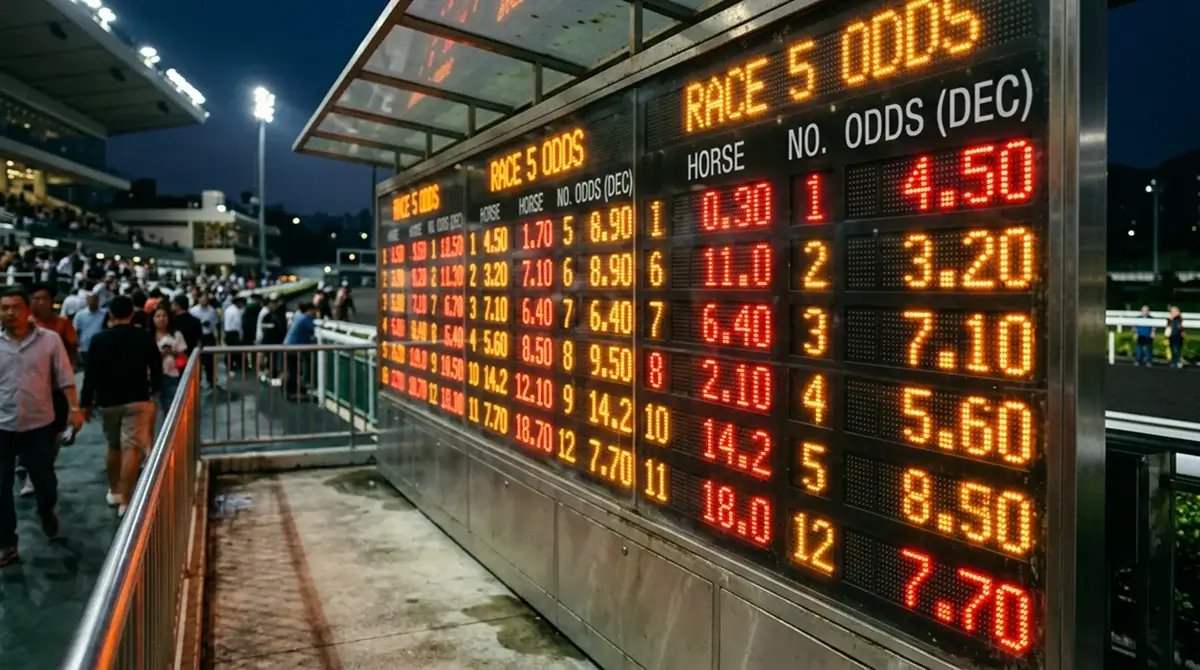
The core bet types translate directly. Win bets, place bets, and each-way wagers work identically whether you are staking in pounds or USDT. The odds formats might default to decimal on crypto platforms rather than the fractional format UK punters grew up with, but the underlying mathematics are the same. Where things diverge is in market depth, the range of bets available on any given race, and in the speed of settlement, which is where crypto’s characteristics start to make a real difference.
Straight Bets: Win, Place, Each-Way
Win and place bets are universally available. Each-way – the backbone of UK horse racing betting – is offered by most crypto sportsbooks with horse racing verticals, but the place terms can vary. Some platforms default to 1/4 odds for place, others offer 1/5, and the number of places paid (two, three, or four) depends on the field size and the individual platform’s rules rather than the industry-standard terms UK bettors expect from licensed bookmakers.
Each-Way Bet Example in USDT
| Component | Calculation | Amount |
|---|---|---|
| Stake | 50 USDT each-way (100 USDT total) | 100 USDT |
| Odds | 8.00 (decimal) – equivalent to 7/1 fractional | — |
| Place terms | 1/4 odds, 3 places | — |
| Win part (horse wins) | 50 x 8.00 | 400 USDT |
| Place part (horse places) | 50 x ((8.00 – 1) / 4 + 1) = 50 x 2.75 | 137.50 USDT |
| Total return if horse wins | 400 + 137.50 | 537.50 USDT |
| Total return if horse places only | 137.50 (minus 100 stake = 37.50 profit) | 137.50 USDT |
With a stablecoin stake, those 537.50 USDT are worth the same in dollar terms at payout as they were at placement. With Bitcoin, the value could be higher or lower depending on price movement during the settlement window.
Exotic Bets and Accumulators
Exactas (forecasts), trifectas, and reversed forecasts are where crypto platforms show the widest variation. Some offer a full card of exotic markets comparable to the Tote or traditional bookmakers. Others only provide win and place markets on non-feature races, reserving exotics for major meetings like the Grand National or Royal Ascot. If exotic bets are a core part of your horse racing approach, platform selection becomes critical.
Accumulators – multi-leg bets across different races – are widely supported. The appeal in crypto is obvious: no maximum payout caps at many offshore platforms, whereas licensed UK bookmakers typically cap accumulator winnings. The flip side is no regulatory oversight if a platform decides to void a leg or delay payment.
Live and In-Play Betting
Live betting now accounts for 53.4 percent of all online wagering at the start of 2026, per DemandSage and CompaniesHistory. For horse racing, live markets are inherently constrained by race length. You might have 90 seconds of in-play opportunity on a five-furlong sprint. Crypto adds a layer to this because stablecoin settlement on custodial platforms is effectively instant (the bet is placed against your account balance, not on-chain), while Bitcoin settlement for deposits or withdrawals carries latency that makes on-chain interaction impractical during a live race.
AI-driven odds adjustment is also entering the picture. Congruence Market Insights reports that AI algorithms can reprice odds 35 percent faster than traditional statistical models – a capability that matters enormously in-play when seconds count. The full breakdown of bet types, including worked calculations for each category, is in my horse racing bet types with crypto guide.
An each-way bet is two stakes: one on the win, one on the horse finishing in the places. The place part pays at a fraction of the odds — 1/4 and 1/5 are the most common terms — and the number of places depends on the field size. On crypto racebooks these terms vary by platform, so always confirm the place fraction and places paid before staking. Stake and returns are shown in USDT; with a stablecoin their dollar value holds from placement to payout. Informational only.
A race lasts two to four minutes, but the deposit-to-withdrawal window can stretch to hours. Over that time Bitcoin’s price commonly swings 3–5% — so you can win your bet and still collect less real value than you staked. A stablecoin removes that risk entirely: the dollar value at payout equals the value at deposit. A negative move is drag; a positive move is upside, but it is uncertainty either way — not something to rely on for bankroll planning. Informational only.
Choosing a Crypto Horse Racing Betting Platform
I have tested more crypto sportsbooks than I care to admit, and the single biggest mistake I see bettors make is choosing a platform based on the welcome bonus rather than the racing product. A 200 percent deposit match means nothing if the platform only covers three UK meetings a week and does not offer each-way terms.
The global online gambling market is worth an estimated 117.5 billion dollars in 2025, projected to reach 186.58 billion by 2029, according to DemandSage and Mordor Intelligence. Within that enormous market, crypto horse racing occupies a sliver – and the platforms serving it vary wildly in quality, depth, and reliability. Here is a framework for evaluating them, built from years of actual use rather than affiliate marketing copy.
What Actually Matters: Five Criteria That Separate Good From Dangerous
Platform Evaluation Checklist
- Licensing jurisdiction: Identify the licence. Curacao, Anjouan, and Kahnawake are common for crypto platforms – each carries different enforcement capacity and consumer protection levels. No licence at all is a hard stop.
- Horse racing market depth: Check whether the platform covers daily UK meetings, not just headline festivals. Test for each-way availability, ante-post markets, and exotic bet types. A platform that only lists the Grand National is not a racebook.
- Supported cryptocurrencies: Confirm which coins and which networks are accepted. A platform that lists USDT but only supports ERC-20 (with its higher gas fees) is a different proposition from one that supports TRC-20.
- Withdrawal speed and minimums: Request a test withdrawal before committing significant funds. Track how long it takes from request to wallet receipt. Note minimum withdrawal thresholds – some platforms set these surprisingly high.
- Security infrastructure: Look for two-factor authentication, SSL certification, and withdrawal address whitelisting. Check community forums and social media for reports of frozen accounts or delayed payouts.
Market Depth: The Factor Most Guides Ignore
The difference between a crypto sportsbook that happens to list some horse racing and a genuine crypto racebook is market depth. I define depth across four dimensions: the number of UK meetings covered per day, the availability of ante-post markets weeks before major festivals, each-way terms that mirror or approach industry standard, and live in-play options during races. Most crypto platforms excel on one or two of these dimensions and fall short on the others. Very few cover all four consistently.
The 25-34 age group makes up 34.1 percent of the global online gambling customer base, per DemandSage, and this demographic is the most likely to overlap with crypto users. They are also, in my experience, the most likely to compare odds across platforms before placing a bet. If a crypto racebook's margins are significantly wider than what a betting exchange offers, that price disadvantage will cost more over time than any sign-up bonus will compensate.
The Uncomfortable Truth About Offshore Crypto Platforms
Every crypto horse racing betting site currently accessible to UK residents operates outside the UKGC's licensing system. That is not a detail to gloss over. It means no access to the GamStop self-exclusion scheme, no Alternative Dispute Resolution through UKGC-approved bodies, no requirement for the operator to segregate player funds, and no regulatory recourse if something goes wrong. The practical risk is real: if an offshore platform decides to confiscate your balance, your options for recovery are limited to whatever the licensing jurisdiction's complaint process offers – which, for some jurisdictions, is effectively nothing.
I am not saying offshore crypto betting is inherently unsafe. I am saying the risk profile is categorically different from betting with a UKGC-licensed bookmaker, and any bettor who does not factor that into their platform choice is making an uninformed decision. For a ranked assessment of what is available, I maintain a list of crypto horse racing betting sites evaluated against the criteria above.
What's Next: Blockchain, Smart Contracts, and Tokenised Racing
If I had to bet on which technology will most change horse racing wagering in the next five years (and I realise the irony of phrasing it that way) I would put my money on smart contracts. Not because they are ready today, but because the logic is irresistible: automated escrow, oracle-fed results, trustless payouts with no bookmaker in the middle. The question is not whether this works in theory. It is whether the infrastructure can handle the complexity of real horse racing.
Smart Contract Betting
The most promising research I have tracked is the academic work on decentralised parimutuel betting – specifically Uedan et al.'s 2025 paper presented at the AINA conference. The concept is straightforward in principle: a smart contract collects bets into a pool, an oracle feeds the race result to the contract, and the contract automatically distributes winnings proportionally. No operator margin. No withdrawal approval. No human intermediary who can freeze your account.
Decentralised parimutuel betting – a wagering system where all bets on a race are pooled in a smart contract. The final odds are determined by the total pool and the distribution of bets. After the race result is confirmed by an oracle (an external data feed), the smart contract automatically distributes payouts to winning bettors. No bookmaker sets or guarantees the odds.
Congruence Market Insights projects that by 2028, blockchain-based settlement systems will reduce transaction errors by 22 percent. That figure matters because errors in traditional betting settlement, such as mispaid bets, delayed payouts, and disputed results, erode trust. Smart contracts do not miscount.
The limitations are real, though. Liquidity in decentralised pools is thin compared to centralised sportsbooks. The oracle problem, ensuring race results are fed accurately and incorruptibly, remains unsolved at scale. And the user experience of interacting with a dApp is still miles behind the one-tap simplicity of placing a bet on a mainstream platform. These are engineering problems, not fundamental flaws, but they will take years to resolve.

Tokenised Racehorse Ownership
NFT-based fractional ownership of real racehorses is moving from concept to execution. Platforms like Maxima, Tokinvest, and Apollo Racing are tokenising stakes in racing animals, allowing investors to buy fractional shares and receive proportional prize money distributions. Evolution Stables launched under VARA regulation in Dubai in 2025. The blockchain gaming market, which encompasses these kinds of tokenised assets, is valued at 279.10 billion dollars in 2026 and projected to reach 1.35 trillion by 2034, according to Fortune Business Insights – suggesting enormous room for growth even in the narrower horse racing segment.
AI-Adjusted Odds and Prediction Markets
AI odds pricing is already in production at some platforms, adjusting prices faster than any human trading team could manage. Combined with blockchain's audit trail, this creates the possibility of fully transparent, algorithmically priced markets where bettors can verify both the odds calculation and the settlement on-chain. We are not there yet, but the components exist.
Crypto Horse Racing Betting: Questions That Actually Matter
Is it legal to bet on horse racing with cryptocurrency in the UK?
There is no UK law that criminalises an individual for placing a bet with crypto on an offshore site. The legal prohibition sits on the operator side – UKGC-licensed bookmakers are not permitted to accept cryptocurrency deposits or withdrawals under their current licence conditions. If you bet on horse racing using crypto, you are by definition using an offshore platform that operates outside UK jurisdiction. You are not breaking the law, but you are also not protected by it. No GamStop, no UKGC dispute resolution, no requirement for the operator to segregate your funds. The UKGC's 2026 initiative to explore a crypto pathway for licensed operators may change this picture, but as of now, no licensed UK betting site accepts crypto.
What are the best cryptocurrencies for horse racing betting?
It depends entirely on your priorities. If you want price stability between deposit and payout, USDT on the TRC-20 network offers the best combination of speed, low fees, and universal acceptance – it processes 2.3 billion dollars in monthly betting deposits globally. If you are comfortable with volatility and want maximum platform compatibility, Bitcoin remains the most widely supported option at roughly 66 percent of crypto gambling volume. For lower fees with faster confirmations than BTC, Litecoin is a solid middle ground. My recommendation for most horse racing bettors: use stablecoins for everyday wagering and keep Bitcoin for long-term holds outside your betting bankroll.
How do crypto horse racing betting odds compare to traditional bookmaker odds?
Crypto sportsbooks typically display odds in decimal format by default, while UK bookmakers traditionally use fractional. The underlying mathematics are identical – 4.00 decimal equals 3/1 fractional. Where differences emerge is in the margin (overround) built into the odds. Some crypto platforms operate with lower overheads than licensed UK bookmakers, which can translate to tighter margins and marginally better prices. However, this is not universal. Many offshore crypto sites build in wide margins because their customers are less price-sensitive. The only reliable way to compare is to check the same market on both platforms before placing a bet.
What are the advantages of using stablecoins over Bitcoin for horse race betting?
The core advantage is elimination of volatility risk. When you deposit 200 USDT, place a winning bet at 5.00 odds, and withdraw 1,000 USDT, that payout is worth the same in dollar terms regardless of what happened in crypto markets during the race. With Bitcoin, a 5 percent price drop between deposit and withdrawal erodes your real profit even on a winning bet. Stablecoins on the TRC-20 network also settle in 1-5 minutes with fees under 2 dollars, compared to Bitcoin's 10-60 minute confirmation times and variable fees. For high-frequency bettors placing multiple wagers across a race card, the speed and stability compound into a material advantage.
Are crypto horse racing betting sites safe and fair?
Safety varies enormously between platforms. A site licensed by Curacao with a verifiable track record, two-factor authentication, and visible community engagement is a fundamentally different proposition from an unlicensed site with no public ownership information. No crypto horse racing site currently holds a UKGC licence, so the consumer protections available to UK bettors are limited to whatever the offshore licensing jurisdiction provides. Before depositing, verify the licence, test a small withdrawal, and check independent reviews. Provably fair technology – where you can verify bet settlement using cryptographic hashes – exists on some platforms but is more common for casino games than sports betting.
How do I deposit and withdraw crypto at a horse racing betting site?
The process follows a standard pattern: create an account, navigate to the cashier or wallet section, select your cryptocurrency, and copy the deposit address. Send crypto from your personal wallet to that address, making sure to select the correct network – sending USDT on ERC-20 to a TRC-20 address will result in lost funds. Deposits typically require between one and six network confirmations depending on the coin and the platform's policy. Withdrawals work in reverse: enter your wallet address, choose the amount and network, and confirm. Processing times range from minutes for stablecoins to hours for Bitcoin during periods of high network congestion.
What is the difference between offshore crypto betting sites and UK-licensed bookmakers?
The differences are structural, not cosmetic. UK-licensed bookmakers must comply with UKGC conditions: identity verification, affordability checks, participation in GamStop, segregation of player funds, and access to approved dispute resolution services. They pay Remote Gaming Duty and contribute to the Horserace Betting Levy Board. Offshore crypto sites – typically licensed in Curacao, Anjouan, or similar jurisdictions – operate under far lighter regulatory requirements. They generally do not require identity verification, do not participate in UK self-exclusion programmes, and are not obligated to segregate player funds. The trade-off is straightforward: offshore sites offer crypto acceptance, fewer restrictions, and sometimes better odds – but with significantly less consumer protection if something goes wrong.
Created by the ”Horse Racing Crypto Betting” editorial team.